

Sustainability
Our commitment to fair and responsible design
The Crewel Collective is committed to championing the very best of Indian craftsmanship and to supporting the ancient craft of hand embroidery by showcasing the amazing talent of the artisans with whom we work to a modern, global audience. We endeavour to work in the most sustainable way possible whilst looking at how we can learn and improve our practices. Our aim is to ensure that we create a more environmentally-friendly future for our part of the textiles industry.
Below, we share our fabrics' journey from start to finish with the aim of offering a transparent view of how our crewel fabric is made and distributed.

Materials
The base fabrics onto which we embroider are either dasuti (thick, hand-loomed cotton made in Kashmir), duck cotton (sourced via agents in Delhi) or linen (manufactured in Bangalore). These are transported by road to Kashmir. The woollen yarn which is used for the embroidery originates in Haryana and is also transported by road to Kashmir.
The woollen yarns are hand dyed in Kashmir using Azo-free dyes, produced by BASF (formerly Hindustan Ciba Geigy Ltd), which are kinder to the environment and our artisans. These dyes comply with the REACH directive and the sustainability and compliance information can be viewed here - BASF Azo-free dyes
Working Conditions
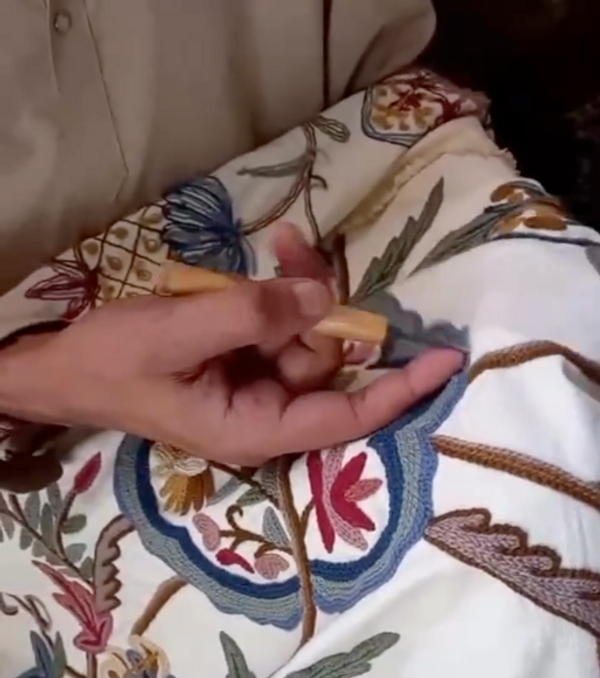
Once the design has been traced onto the base fabric, the cloth and woollen yarn are given to individual embroiderers who work either alone in their homes or collectively within their villages to create our embroidered fabrics.
The Crewel Collective is committed to ensuring that the artisans who create our fabrics are fairly compensated and work under ethical conditions. Our contacts who oversee the work are registered with the Export Promotion Council for Handicrafts and comply with the EPCH's social and ethical compliance standards. We maintain a Stitcher Log to enable us to trace production back to specific artisans, ensuring adherence to ethical work practices. The piece-rate paid to our home-based artisans is renewed annually and is in line with the wage recommendations set by the Jammu & Kashmir government.
Each design is embroidered in batches by hand. Many of our artisans also farm the verdant Kashmir Valley and so crewel production is scheduled around the farming season. When intensive work needs to be done on the land, for example for sowing or harvesting, we reduce the level of crewel fabric production. In the winter months when the farmers are unable to productively work their land we increase crewel production.
Crewel embroidery is a very skilled art which is handed down from generation to generation. It takes at least 3 years to be considered skilled but we only work with the finest master craftspeople, many of whom have been producing embroidery of the finest level for considerably longer.

Sampling and Surplus
Since crewel embroidery is so skilled and takes a considerable amount of time and patience to create, we are careful about the number of samples we provide. Offcuts are often used for the sampling process and we promote the use of returnable large-scale samples for designers' use as well as offcut samples.
Offcut samples are able to demonstrate thread colour and background cloth while large scale samples (1m+ length x full width) provide the full pattern repeat for each design. Both are held in the UK by our Chelsea Design Centre Showroom at Tissus d'Helene. They can be obtained easily from the showroom to take on site or show to clients.
In addition to the larger "road kit" samples, our clients in America are able to access and retain smaller samples from each of the Wells Abbott Showrooms in which we are represented - New York, Chicago, Dallas and Houston.
We aim to use no more than 4m of fabric per design for small sample swatches per batch.
Logistics
Each roll of fabric is approximately 20m in length and is rolled onto a carboard tube, packed and sent to our UK warehousing and distribution centre in Petersfield via air freight. Our minimum order with our artisans is 100m per design/colourway and we try to ensure each delivery is as efficient as possible. We maintain production throughout the year with regular deliveries to maintain consistent work for our artisans. Our UK logistics suppliers are UPS & Fedex.
Our warehouse is also committed to reducing its impact where possible and when fabrics are dispatched each order is cut and rolled onto a cardboard tube which can be recycled easily through most waste recycling centres. The roll is then packaged into a wrap made from post-consumer waste which protects the fabric from being damaged. 93% of waste is recycled and the company is trialling new materials such as potato starch wraps and alternatives to vinyl tape.
Travel to India is carefully considered and kept to a minimum. We are looking into offsetting carbon emissions from flights through Gold Standard Marketplace. Wherever possible digital communication is used to minimise air miles.
