

Craftsmanship
.jpg)
The Art of Crewel Embroidery
Kashmiri Crewel embroidery which is known locally as Aari Kaem (Aari work) is an art form born of traditional skills handed down through generations. Many of the artisans with whom we work are third or fourth generation embroiderers who often combine creating beautiful crewel fabric with seasonal farming in the verdant Kashmir Valley.
The origins of crewel embroidery in Kashmir are deeply intertwined with the region's position on the historic Silk Road. It is widely thought that the Persian mystic and scholar Mir Sayyid Ali Hamadani brought skilled craftsmen from Persia and Central Asia to Kashmir, introducing the Aari (the specialized hooked needle). During the later Mughal era, Kashmiri embroidery was highly sought after as emperors commissioned enormous embroidered wall hangings, tent linings and floor coverings to mimic the lush gardens of Kashmir.


From Fibre to Fabric
The creation of crewel fabric is rarely a solo endeavour, it is a collaborative process that passes through several specialized hands.
Firstly the fabric is prepared. The raw Dasooti (a thick, hand-loomed cotton) or linen is thoroughly washed to prevent any future shrinkage, dried and tightly ironed to create a smooth, taut canvas for the design.
Next, a specialized pattern drawer, known as a Naqash, traces the design onto the fabric using a perforated tracing paper and a specialized washable ink or charcoal powder.
At the same time as the pattern is being traced onto the base cloth, the wool is being prepared using environmentally friendly Azo-free dyes. The master dyer prepares the yarn which for true crewel embroidery is either 1-ply or 2-ply woollen yarn. The Crewel Collective only uses 2-ply yarn as this denotes a higher quality, tighter and more durable finish. The wool is dyed in large vats by artisans who ensure continuity of colour between batches by maintaining a comprehensive library of coloured threads for each design. The wool is left to dry in the open for 12 hours before being sent to the embroiderers.


Bringing the Design to Life
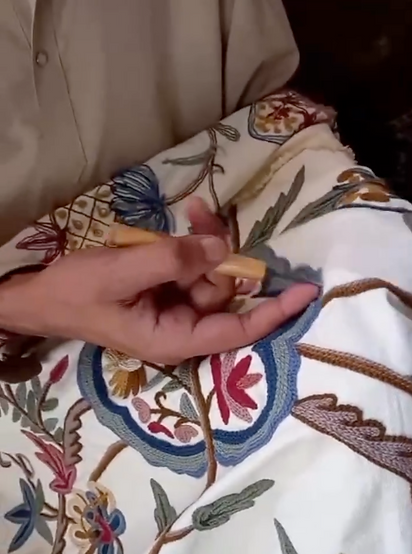
Once the background cloth and woollen yarns are prepared they become the responsibility of the embroiderers who use an Aari hook to fill in the design. The artisan sits on the floor, sometimes working alone but often working with 1 or more embroiderers creating the same 50m roll of fabric. Holding the yarn under the fabric and the Aari hook above, each artisan works with incredible speed and rhythm, punching the needle through, catching the yarn and pulling it up to create concentric rings of continuous chain stitches, slowly filling in the motifs. Depending on the complexity of the design and the number of coloured wools involved, it can take one artisan up to three days to complete one metre of embroidered fabric.
Once the embroidery is complete, the piece is gently hand-washed. This crucial step removes the tracing ink, sets the woollen stitches securely into the base fabric and slightly "felts" the wool to give it a uniform luxurious texture.
At the final stage, the fabric is checked once more for marks or imperfections in the cloth. If any are found the artisans will embroider an additional design over the top to ensure that the whole length of fabric is not discarded. This not only ensures that the fabric, skill and hard work of the master craftsman is not wasted, it also ensures that each roll of fabric is unique. No two rolls of the same fabric design are identical. Each bears the hallmark of its maker's skill and patience.